Showing posts with label chemistry. Show all posts

Thursday, July 14, 2016

Basic Science #8: Heavy Water. Hydrogen and Deuterium are Isotopes

Have you heard of HEAVY WATER?
Regular water  H2O, is made of two hydrogen atoms, one oxygen.
Hydrogen (H) has one proton and one electron, its atomic (proton) number is 1 with a mass of 1 Dalton.

Hydrogen has an isotope, meaning another element with the same number of protons, i.e. the atomic number, but a different mass of 2 Daltons because it has an extra neutron.  Thus, deuterium (D) is a stable isotope of hydrogen, it has 1 proton, 1 electron and 1 neutron.


Deuterium is a heavy isotope of hydrogen. Some of the water on earth has one or two deuterium atoms replacing the hydrogen.  D2O is heavy water as the deuterium is two times heavier than hydrogen.
Water is essential for life.  In our planet you can find water in all 3 phases: As ice in the glaciers, as water in the oceans and as vapor in the clouds.  Vapor of water contains deuterium and that makes water to have a higher viscosity and boiling point. Natural vapor or moist is always deuterium depleted compared to its water source and it always covers water and even ice.


Water-Cycle: A lesson from elementary school.  Remember?

As water tends to evaporate, it is the regular water that evaporates into clouds.  The water sitting in the depths will be enriched with deuterium, the heavy isotope of hydrogen, or heavy water.
I don’t recommend drinking heavy water.  D20 tastes almost exactly like H20. However, seeds will not sprout in heavy water, and when rats are given heavy water exclusively, they die of thirst although glutted with water. The D atom causes all processes in the body to slow down or come to a halt.
I’d like to introduce a dear esteemed colleague of mine, Laszlo G. Boros MD.


Dr. Boros has recently come upon the idea that we have been exposed too long to variable high levels of heavy water in our food and in our environment.  He has been studying the levels of D in different food sources and in many cancer patients.  He has published a number of scientific papers to test the assumption that deuterium depletion can be therapeutic in treating tumors.  
On top of all that he is convinced that some old civilizations knew about all this.  Most likely Dr. Boros believes this knowledge is conveyed in the Torah, in the five books of Moses.
Check out this presentation where Dr. Boros reads the Torah word by word and links it to biology and physics: 

Would appreciate any comments or questions.  It is a revolutionary idea.


Wednesday, April 13, 2016

Basic Science #7: Albumin

Albumin is a large abundant protein in our blood.  When blood is collected in a tube and left to stand, the red cells, containing hemoglobin will sink to the bottom.  The liquid on top is called serum or plasma.   Albumin gives it the yellowish color.  Serum also contains various components important for our overall health.  The white blood cells and platelets will be in between these two layers - in the interphase.


We should all know about a blood test for Albumin (by my health care provider):
Normal amounts of Albumin: 3.3 - 4.8 g/dL. Albumin is a protein that is made in the liver and released into the blood. It helps keep the blood from leaking out of blood vessels. Albumin also helps carry some medicines and other substances through the blood and is important for tissue growth and healing.
Chemistry of albumin: Human serum albumin - HSA is made of 609 amino acids.  (Yes six hundred and nine amino acids!)  Bovine serum albumin - BSA has a very similar chemistry with small differences in amino acid sequence.   Here is the 3D structure of both proteins pointing out this specific difference:

Human and Bovine Serum Albumin:


The similar structure of albumin in various organisms can be followed from lower organisms to higher ones.  This is the scientific base of evolution.  In comparative genetics the scientists can compare the amino acid sequence of mouse, rat, dog, bovine and human and show the homology.  There is a higher fit or homology between human and bovine, than between human and mouse.
Albumins belong to a group of proteins described as globular proteins, referring to their spherical shape.  This shape makes them soluble in water, so their location in the cell is in the aqueous, or water environment.  Some proteins are membrane proteins which means they are not soluble in water and will be attached to the cell wall or membrane. 
An important aspect of biochemistry of proteins is transport of nutrients or drugs depending on their solubility in water.  Albumin has an important role as a “universal” solvent.  Here you can see how Albumin can attach various molecules as fatty acids which are lipids, or calcium which is a small ion, and transfer them through the blood to their destination in the body.


Albumin attached to various drugs and nutrients:


In this post on Albumin I have introduced the principles of soluble and membrane proteins and some basis of evolution. I hope more people would study these topics and learn to appreciate our amazing complex biology.

Thursday, March 10, 2016

Basic Science #6: Hemoglobin

Hemoglobin was the first protein that we studied in biochemistry.  I have great fondness for this protein. 
Before I start talking about the chemistry of hemoglobin you should remember a few facts:
*Everybody knows this important protein in our blood. 
*It gives blood the red color because it contains an iron ion. 
*It is essential for binding oxygen and so it gives us energy. 
*Levels of hemoglobin in the blood are measured in any standard blood test. 
*Hemoglobin levels are higher in men than in women and that is one reason why men are usually stronger.
*Hemoglobin levels correlate with the number of red blood cells and levels of iron.  If hemoglobin levels are low it is often caused by iron deficiency anemia.
*The part of the protein that contains iron is called heme.
As I was studying the biology of proteins one fact always amazed me.  My childish impression was that the protein was made once and stayed like that.  But I found out that our cells are continuously making and breaking the proteins according to their need in the machinery of the cell.  If your cell needs the energy it will make more hemoglobin.  While you rest it will break down the protein to its individual amino acids.  And both these processes are very finely controlled.  It is amazing how super intelligent our cells are.

Chemistry of hemoglobin.

Check out this 3D model of hemoglobin:


Hemoglobin is made of 564 amino acids.  Molecular weight of hemoglobin is around 50,000 (For comparison: Oxygen molecule is 16, it fits in a small pocket of hemoglobin.)
Now try to imagine how these 564 amino acids fold in the cell to make the two subunits: and b. These two subunits then double up to form a tetramer with two of each subunit.  Then the heme is inserted in each of the four subunits for a fully active protein enabling the special function of the hemoglobin - the transfer of the oxygen.  An alteration of any part of this structure of hemoglobin would cause inability to execute its duty of carrying oxygen.
I was really amazed to learn how complex is the structure of such an important basic protein.  The more I learn about the mechanism of action of proteins in our biology I am stunned to see the intricacy of it all.  

To add to the complexity of this we now measure levels of hemoglobin a1c in diabetes patients.  The high level of glucose molecules in the blood causes them to attach to the hemoglobin to form glycated hemoglobin:


I am thankful every day for the way my cells allow me to continue breathing and thinking, running and dancing!

Friday, February 19, 2016

Basic Science #4: Amino acids as building blocks for proteins.

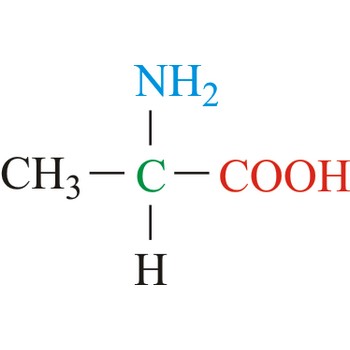
Amino acids are the basic building blocks of proteins.  Proteins can be very complex, up to thousands of amino acids attached to each other in a chain to make a protein.  Here is a simple amino acid: Alanine.  As I showed you it has an amino group NH2 which is basic (blue) in pH and a carboxyl group COOH which is acidic (red.)

Two amino acids are connected to each other in a peptide bond.  The next amino acid will be connected to the previous peptide via the carboxyl group, so that each chain of amino acids bound together will have an amino end and a carboxyl end.


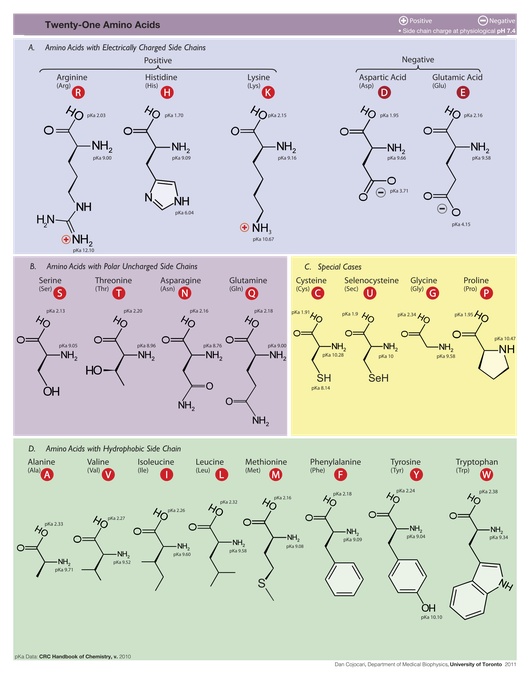
To understand the complexity of proteins I will bring here a table of the 20 amino acids in life.  The names of the acids were given by the Greeks historically according to their source (like Serine was isolated from silk) or their color (Leucine for white.)  But it is more important to understand their diversity in structure. The position of the amino acid in the protein will determine how the protein will interact with its surroundings and what will be its activity. 
To envision this check the following table.  The amino acids are categorized in 5 groups.  First by their interaction with water: a hydrophilic amino acid  will be in a water environment and a hydrophobic amino acid (turquoise) will be in a fat environment as a cell membrane of a fat cell.
Next the hydrophilic amino acids can be polar but uncharged (grey.) They can be basic with two amino groups (blue) or acidic with two carboxyl groups (red.)


The order of the amino acids in the chain is just the primary structure of the protein.
The next level of complexity is the secondary structure, the way this amino acid chain twists and turns, as a helix.  Sometimes to the right, sometimes to the left and this is called and b helix.


The next level is the tertiary structure, this is caused by bridges of bonds between two different parts of the protein.  These bridges are made with di-sulfide bonds between two amino acids that contain sulfur: Cysteines. 

There is a Quaternary structure as well by combining a whole folded protein with another similar (or different) sub-unit to make a dimer, a trimer and so on.  All the different possible combinations exist.  This is one way to show how we have such an amazing beautiful diversity in life!

Monday, January 4, 2016

Basic Science #2: Acids and Bases

Thanks to my readers who responded with interest to my basic science post.  Someone asked if the next element is going to be nitrogen?
I am now suggesting this order: we first talk about hydrogen then water then acids and bases.  Next nitrogen, ammonia carbon dioxide.  Then amino acids.
Hydrogen is element number 1.  One proton one electron.  The most abundant element on our planet. Oxygen is element number 8.  Oxygen is what we inhale and is essential for our survival.
These two elements give us WATER which is also essential for our survival.  H2O.
 
The water molecules has two ions in equilibrium: H+ proton and OH- hydroxyl:

When the amount of protons and hydroxyls is equal the pH is neutral, or pH=7.
When the protons are in a higher concentrations, then the pH is acidic.  Examples: When we eat acid is pumped into our stomachs to a pH as low as ONE in order to digest the food.
Vinegar and lemon juice are also acidic.  Interesting to note here that the Hebrew word for acid comes from the rood that means sour.  Any foods with a sour taste are acidic.
When the hydroxyl ion is in high concentrations the pH is basic.  Examples are baking soda and drain cleaners.  Bases usually taste bitter.
 
Now we are ready to talk about nitrogen.  Element number 7.  Nitrogen interacts with hydrogen to form ammonia: NH3. 
 
 
 Ammonia has a bad smell.  When dissolved in water ammonia will become basic:


Everyone is familiar with carbon dioxide CO2.
CO2 in water:
 Yes, this will be slightly acidic.

Now we are ready to understand what is an amino acid.  Amino acids are the building blocks of proteins in our food and in our bodies.  There are 22 amino acids in life. 
A simple amino acid is alanine:
The amine group is in blue.  The red group is the organic acid COOH.

Here is a chart of the various amino acids categorized by their chemical structure:

 http://rosalind.info/media/amino_acid_table.png

 Hope this post will help those who want to understand better.


Wednesday, December 23, 2015

Basic Science #1 Carbon Chemistry

I hope to write a series of posts on basic science, retelling the most memorable lessons in my life.  Basic science is the a discipline that combines all areas of mathematics with physics, chemistry and biology on the most theoretical level.  Not necessarily any immediate applications.  But the beauty of basic science is that it is universal and basically the truth.
This first lesson was in my senior year in high school, introduction to organic chemistry.  In the two previous years of chemistry studies I basically knew about the periodic table of elements like hydrogen, helium, carbon, nitrogen, oxygen and so on. Nothing was standing out as exciting or amazing.
Organic chemistry is basically the chemistry of carbon.  Carbon is the basic element in all of life.  It is in the backbone of sugars, proteins and fats.  What is special about carbon?  Carbon has 4 electrons in its outer shell, so it can share these equally with another element by creating a bond that is represented either as two dots or a line.
The interesting thing about carbon is the diversity of the compounds that it can be found in.  In this lesson we learned about two substances made of only carbon:  Diamond and graphite:
Diamond is the hardest substance and graphite is soft and powdery.  The memorable phrase was: "Vive la petite difference!"  (Doesn't sound as nice in English: long live the difference.)


You can see there are only carbons in these two substances.  In diamond each carbon is connected to four other carbons making perfect 60 degrees angles equally distanced in space.  This perfect crystal structure gives it the hard quality.
In graphite the angles are not all the same, there are flat layers of carbons attached in strong bonds, connected to layers above and below attached in much weaker bonds that cause this substance to be powdery.


This lesson is unforgettable.  It taught me the importance of geometry in studying chemistry and biology.  It clarified the stick and ball models used to describe and predict the structure and activity of molecules in nature and in life.


Wednesday, October 7, 2015

Things I Learned from my Mother: Helping Others


Here I want to tell you the stories of things I learned from my mother.  My dear mother who passed away in 2013, may she rest in peace.
What can I tell about my mother?  This was a woman who knew everybody and helped all.  We all loved and appreciated her.  I was sad to leave my mother when I married and ended up raising my sons far away in California.

My mother visited me one time when I was sick, she loyally took care of me and helped me in such an impressive way that I shall never forget it.  We had many close conversations about our childhood hers in her homeland in Mashhad and mine in our new country Israel.  My mother Rivka then told me a story about her mother, Mina who raised six children.  All the kids were asleep and Mina was still sitting at the sewing machine and sewing clothes way into the wee hours of the night. Little Rivka asks her mother: “Why are you working so hard so late at night?”  My grandmother answers: “We are good people who like to help the poor.  We are unable to help them with money or with goods therefore I devote my time to make clothes for their little children.”
I was very impressed with this story and I understood that this was one of the important values in my family: there are always people with fate worse than ours and we should help them.
This is what I meant in my previous post when I spoke about innate responsibility to help the less fortunate.  I had some strong reactions against that sentiment.  Some people saw the political angle: “We don’t need the government!”  That is so regrettable that our political views blind us from watching our fellow human beings.  I think personal responsibility is the most innate value we should remember.  My Bell Curve just showed distribution of IQ.  But people who are fortunate in other areas of life, they also have something to contribute.  People with artistic talents entertain us and tell us stories.  They create beautiful art and enhance our sense of awe.  Scientists and engineers discover the secrets of our universe and create technologies to improve our lives.  Even the physically handicapped have emotional power to help us when we are sad.  It is an amazing world of diverse life.

I’d like to show you this photo of my family from the 1950’s with my two grandmothers all living in one small house.  But helping others was something I learned to cherish.
Ever since I remember, mother loved to help people.  She had an incredible memory and she knew every family member of every relative and acquaintance who came to Israel from the old country.  On one hand she knew the successful, rich families who moved to New York, with the large homes and fancy parties.  (She got invited to many of these parties…)  On the other hand she knew the less fortunate people who could not afford to support their large families or their sick and disabled children.  She had an amazing ability to mix in any society and find friends who loved her.  This way she had always been successful in convincing the rich to donate money to those in need.
Mother always reminded us of the memorials for our grandparents: It is important to remember.  I could continue and mention more examples of how mother loved to help everybody.  Not only she felt an obligation to help, she did it with pleasure and tremendous joy.  And that is the main lesson: To revere the joy you feel by helping others.
Maybe in the modern world today it is not as simple to figure who can use help and who needs to be punished.  Here is where our intelligence and imagination can guide us in figuring out how to achieve this balance.