Showing posts with label nature. Show all posts

Wednesday, April 13, 2016

Basic Science #7: Albumin

Albumin is a large abundant protein in our blood.  When blood is collected in a tube and left to stand, the red cells, containing hemoglobin will sink to the bottom.  The liquid on top is called serum or plasma.   Albumin gives it the yellowish color.  Serum also contains various components important for our overall health.  The white blood cells and platelets will be in between these two layers - in the interphase.


We should all know about a blood test for Albumin (by my health care provider):
Normal amounts of Albumin: 3.3 - 4.8 g/dL. Albumin is a protein that is made in the liver and released into the blood. It helps keep the blood from leaking out of blood vessels. Albumin also helps carry some medicines and other substances through the blood and is important for tissue growth and healing.
Chemistry of albumin: Human serum albumin - HSA is made of 609 amino acids.  (Yes six hundred and nine amino acids!)  Bovine serum albumin - BSA has a very similar chemistry with small differences in amino acid sequence.   Here is the 3D structure of both proteins pointing out this specific difference:

Human and Bovine Serum Albumin:


The similar structure of albumin in various organisms can be followed from lower organisms to higher ones.  This is the scientific base of evolution.  In comparative genetics the scientists can compare the amino acid sequence of mouse, rat, dog, bovine and human and show the homology.  There is a higher fit or homology between human and bovine, than between human and mouse.
Albumins belong to a group of proteins described as globular proteins, referring to their spherical shape.  This shape makes them soluble in water, so their location in the cell is in the aqueous, or water environment.  Some proteins are membrane proteins which means they are not soluble in water and will be attached to the cell wall or membrane. 
An important aspect of biochemistry of proteins is transport of nutrients or drugs depending on their solubility in water.  Albumin has an important role as a “universal” solvent.  Here you can see how Albumin can attach various molecules as fatty acids which are lipids, or calcium which is a small ion, and transfer them through the blood to their destination in the body.


Albumin attached to various drugs and nutrients:


In this post on Albumin I have introduced the principles of soluble and membrane proteins and some basis of evolution. I hope more people would study these topics and learn to appreciate our amazing complex biology.

Friday, February 19, 2016

Basic Science #4: Amino acids as building blocks for proteins.

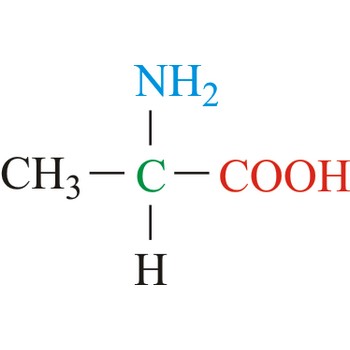
Amino acids are the basic building blocks of proteins.  Proteins can be very complex, up to thousands of amino acids attached to each other in a chain to make a protein.  Here is a simple amino acid: Alanine.  As I showed you it has an amino group NH2 which is basic (blue) in pH and a carboxyl group COOH which is acidic (red.)

Two amino acids are connected to each other in a peptide bond.  The next amino acid will be connected to the previous peptide via the carboxyl group, so that each chain of amino acids bound together will have an amino end and a carboxyl end.


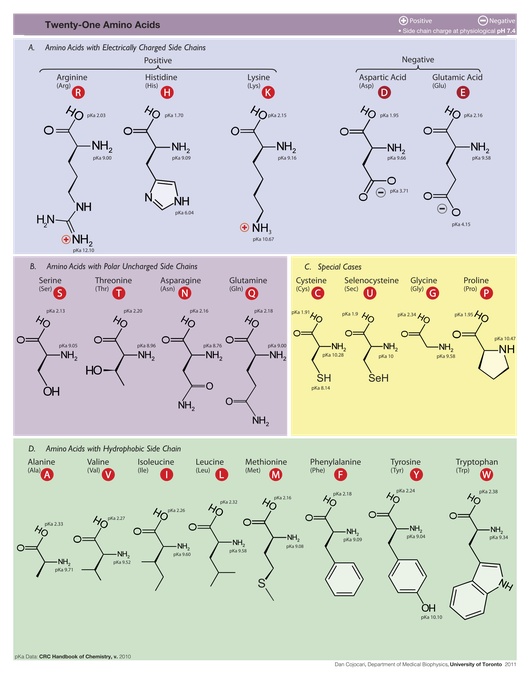
To understand the complexity of proteins I will bring here a table of the 20 amino acids in life.  The names of the acids were given by the Greeks historically according to their source (like Serine was isolated from silk) or their color (Leucine for white.)  But it is more important to understand their diversity in structure. The position of the amino acid in the protein will determine how the protein will interact with its surroundings and what will be its activity. 
To envision this check the following table.  The amino acids are categorized in 5 groups.  First by their interaction with water: a hydrophilic amino acid  will be in a water environment and a hydrophobic amino acid (turquoise) will be in a fat environment as a cell membrane of a fat cell.
Next the hydrophilic amino acids can be polar but uncharged (grey.) They can be basic with two amino groups (blue) or acidic with two carboxyl groups (red.)


The order of the amino acids in the chain is just the primary structure of the protein.
The next level of complexity is the secondary structure, the way this amino acid chain twists and turns, as a helix.  Sometimes to the right, sometimes to the left and this is called and b helix.


The next level is the tertiary structure, this is caused by bridges of bonds between two different parts of the protein.  These bridges are made with di-sulfide bonds between two amino acids that contain sulfur: Cysteines. 

There is a Quaternary structure as well by combining a whole folded protein with another similar (or different) sub-unit to make a dimer, a trimer and so on.  All the different possible combinations exist.  This is one way to show how we have such an amazing beautiful diversity in life!

Thursday, January 14, 2016

Basic Science #3: The Beauty and Power of Mathematics


Natural Numbers

I would like to convey to my readers my love and appreciation for mathematics.  I happened to be able to grasp basic concepts at an early age.  Many of my classmates were not as fortunate.  Decades later I still have friends tell me about their struggles with these concepts.  I believe that with better more diverse teaching methods more and more kids will grow up with a better grasp and understanding of math concepts.
Mathematical constants or natural numbers are the basic alphabet of the laws of nature.  The laws of nature are the laws that govern our physical and biological worlds.
I will start here with one of the very first natural numbers we all hear about the constant Pi. The number Pi is close to 3.14 and is the ratio between the circumference of the circle and its diameter.  This ratio is always the same regardless of the size of the circle or where you find the circle.  It could be in biology or architecture or in space.


I have this vision or maybe you'd call it a dream: any kid who learns to count and recognizes shapes, should be able to understand the concept of pi.  This concept is so basic that every boy and girl could understand it.
This is the blackboard from the movie "The Life of Pi."  The Indian boy named Pi who remembered this number to many decimal points:

Other laws of nature could be explained at a younger age: the power of gravity - why do we fall down?  The power of magnetism - the magnets we stick on our refrigerators.
Many great minds have observed these powers and managed to describe them in mathematical terms.  We have the tools to measure these powers and give them exact quantities.


Next I would like to talk about the number e a relative newcomer on the mathematics scene compared with pi.  This number has a role as the "natural" base for exponential functions and logarithms.  It is also derived from trigonometry and we can find it in many examples as in calculating compound interest.

e = 2.71828182845904523536...

e = 1 + 1/1! + 1/2! + 1/3! + 1/4! + ...
The next mathematical concept that is used in many fields of science is the “imaginary” number i.  When you square this number you get negative one: -1.  Or


I would like to bring here one of the most amazing equations that show how these three mathematical constants are related to each other and to the basic laws of life. 
Euler's equation:

If this equation does not blow your mind I don't know what will.  Why is it important?  I hope you agree that this is beautiful!  It shows such promise in the power of math to help solving many complex issues and unrelated problems.

Monday, January 4, 2016

Basic Science #2: Acids and Bases

Thanks to my readers who responded with interest to my basic science post.  Someone asked if the next element is going to be nitrogen?
I am now suggesting this order: we first talk about hydrogen then water then acids and bases.  Next nitrogen, ammonia carbon dioxide.  Then amino acids.
Hydrogen is element number 1.  One proton one electron.  The most abundant element on our planet. Oxygen is element number 8.  Oxygen is what we inhale and is essential for our survival.
These two elements give us WATER which is also essential for our survival.  H2O.
 
The water molecules has two ions in equilibrium: H+ proton and OH- hydroxyl:

When the amount of protons and hydroxyls is equal the pH is neutral, or pH=7.
When the protons are in a higher concentrations, then the pH is acidic.  Examples: When we eat acid is pumped into our stomachs to a pH as low as ONE in order to digest the food.
Vinegar and lemon juice are also acidic.  Interesting to note here that the Hebrew word for acid comes from the rood that means sour.  Any foods with a sour taste are acidic.
When the hydroxyl ion is in high concentrations the pH is basic.  Examples are baking soda and drain cleaners.  Bases usually taste bitter.
 
Now we are ready to talk about nitrogen.  Element number 7.  Nitrogen interacts with hydrogen to form ammonia: NH3. 
 
 
 Ammonia has a bad smell.  When dissolved in water ammonia will become basic:


Everyone is familiar with carbon dioxide CO2.
CO2 in water:
 Yes, this will be slightly acidic.

Now we are ready to understand what is an amino acid.  Amino acids are the building blocks of proteins in our food and in our bodies.  There are 22 amino acids in life. 
A simple amino acid is alanine:
The amine group is in blue.  The red group is the organic acid COOH.

Here is a chart of the various amino acids categorized by their chemical structure:

 http://rosalind.info/media/amino_acid_table.png

 Hope this post will help those who want to understand better.


Wednesday, December 23, 2015

Basic Science #1 Carbon Chemistry

I hope to write a series of posts on basic science, retelling the most memorable lessons in my life.  Basic science is the a discipline that combines all areas of mathematics with physics, chemistry and biology on the most theoretical level.  Not necessarily any immediate applications.  But the beauty of basic science is that it is universal and basically the truth.
This first lesson was in my senior year in high school, introduction to organic chemistry.  In the two previous years of chemistry studies I basically knew about the periodic table of elements like hydrogen, helium, carbon, nitrogen, oxygen and so on. Nothing was standing out as exciting or amazing.
Organic chemistry is basically the chemistry of carbon.  Carbon is the basic element in all of life.  It is in the backbone of sugars, proteins and fats.  What is special about carbon?  Carbon has 4 electrons in its outer shell, so it can share these equally with another element by creating a bond that is represented either as two dots or a line.
The interesting thing about carbon is the diversity of the compounds that it can be found in.  In this lesson we learned about two substances made of only carbon:  Diamond and graphite:
Diamond is the hardest substance and graphite is soft and powdery.  The memorable phrase was: "Vive la petite difference!"  (Doesn't sound as nice in English: long live the difference.)


You can see there are only carbons in these two substances.  In diamond each carbon is connected to four other carbons making perfect 60 degrees angles equally distanced in space.  This perfect crystal structure gives it the hard quality.
In graphite the angles are not all the same, there are flat layers of carbons attached in strong bonds, connected to layers above and below attached in much weaker bonds that cause this substance to be powdery.


This lesson is unforgettable.  It taught me the importance of geometry in studying chemistry and biology.  It clarified the stick and ball models used to describe and predict the structure and activity of molecules in nature and in life.


Monday, December 14, 2015

In The Regenerative Garden with Natalie Sunshine


I had a best tasting fresh salad at my son’s Hanukkah party.  I was wondering which garden produced such tasty dill and Swiss chard.  I was delighted to be corrected that Natalie has not one but many gardens around Venice.  I immediately became best friends with this wonderful gardener who is pioneering the idea of regenerative gardens in the city.  She invited me to come to one of her classes and learn the basics of composting, germinating and planting.  She also told me to bring any compost I have at home.  I would like to share here what I have learned.
The garden at 681 Venice Blvd is supported by the organization Kiss the Ground. 


As you can see in the sign: Venice Arts Plaza Regenerative Garden:


Natalie’s smile which is just like sunshine greeted me happily.  I handed her my bag with vegetable and fruit peels and similar trash.  We started by throwing our trash on top of the pile of soil and trash enclosed in a wooden frame.  Then she used a large pitchfork to mix it all and took a handful of the soil to show me how alive it is with healthy bugs necessary for regeneration and growth.
 
 
We moved on to the vermiculture: the compost pile started with red wigglers.
I remember these worms from my childhood.  Every winter right after the rain we used to dig in the ground and find these worms.  Our Science teacher explained how important they are in mixing the soil and accelerating germination and growth.  Natalie showed me that this pile is covered with straw on top.  At the bottom there is a filter and the excrement from the worms is collected.  She gathers it up biweekly and has a container of "tea" that she gives to other gardeners to fertilize their gardens. 
The next lesson was on germination: I used seeds of my choice to plant in pots that we placed in the green house.  My heirloom radishes should be ready in 45 days!  The pots contained seedlings planted by some kids.  We took some of the arugula plants and transferred them to the raised beds in the garden.


Note the yellow butterfly flying happily around the flowers:

I am really excited about this idea of regenerating the soil around the gardens in the city and teaching people to grow their own food.  Natalie told me how she learned some of these ideas from her farming family in Mexico who used sun flowers to regenerate the soil.  Different parts of the plant are used for various purposes.  But what I like best about sunflowers is the pattern of the seeds:

This pattern can be described mathematically by the Fibonacci numbers:

The first two Fibonacci numbers are 0 and 1. Each number after is the sum of the previous two.
0, 1, 1, 2, 3, 5, 8, 13, 21, 34, 55, 89, etc.
Fibonacci, called the Golden Ratio at its perfection, occurs beautifully in nature.

These are the things that excite me about science and nature.

Will close with a message about our earth: