Sunday, August 30, 2015

Family traditions and homelessness

Imagine these three women:  A young mother who is an aspiring author, a young mother who is homeless and a Persian lady who is a recent immigrant to California.
The author is visibly troubled by the sight of the young mother sitting on a bench in the promenade next to her baby carriage for over two hours.  She approaches the mother on the bench with an offer to help.  The young mother has no job and no place to go.  So the author arranges for her to stay one night in a motel.  This small episode brings the author to write her next novel on shelters.  There are plenty of homeless shelters  in Los Angeles.
Laura Nicole Diamond:
Shelter Us book cover:


A Santa Monica shelter for homeless women-Ocean Park Community Center:

I attended the Author Talk at my local library and that is where I met the Persian lady.
(I prefer the term Persian and not Iranian which was invented by the British in the past Century.)  The Persian lady seems just as gentle and caring as the young author.  She heard us talk about different shelters across the city and she was incredulous: “Why do people have to be homeless?  How come they have nowhere to go?  Whatever happened to the parents, there must have been grandparents, aunts or uncles?  What kind of society is it when parents tell their kids: You are eighteen and you are out?” 
My extended family all came from Mashhad in the North Est part of Persia.  I understood what the Persian lady was talking about.  No one is left homeless.  The mentally ill, the physically challenged all find a home with the extended family.  They are rarely put away in any sort of institution.  The bright and able take care of the weak and feeble.  But the other side of this scenario is that sometimes young people feel trapped.  They have to follow the family structure and “orders”.  Some dominant mothers will insist on picking spouses for their children, and after the wedding there are the orders: You need to have a kid.  And it is time for another one.  Freedom and imagination can hardly flourish.  So here in the area family structure and tradition there is a fine balance.
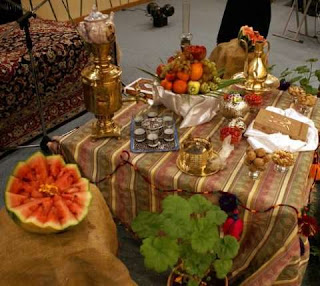
A typical table in a Persian home: Always hot water and tea in a samovar, a bowl of fruits, nuts and cakes.  Welcoming everyone with warm hospitality:
The idea of extended family is very well established in other societies.  I have read this from one of my favorite authors, Isabel Allende who was a refugee from Chile:
http://www.theguardian.com/lifeandstyle/2013/sep/13/isabel-allende-my-family-values
“I have been a foreigner all my life, first as a daughter of diplomats, then as a political refugee and now as an immigrant in the US. I have had to leave everything behind and start anew several times, and I have lost most of my extended family. Here in California, I have tried to recreate a sense of extended family with a few chosen loyal friends. I call them "my tribe". It works better than a real family because we are together by choice not obligation. My grandchildren have grown up in this little tribe and I don't think they are aware that we are not even blood-related.”
I feel strongly that churches, synagogues, mosques and monasteries by and large served their communities by taking in widows and orphans.  The universal sermon is to be kind to the poor and needy.
If we want to live in a society with all these freedoms to pursue happiness and get education and marry our heart’s desire, then I believe we should all work on a policy to prevent homelessness.  

Monday, August 17, 2015

Culinary East meets West


The main news item this past week was the 70th anniversary of the dropping the atom bomb on Hiroshima and Nagasaki in Japan.  There were memorials, apologies, and all signs of soul searching.  Were we right to do this?  Was it worth the life of another million soldiers?  Where do we go from here?  How do we stop Iran from building an atom bomb?
There are no simple solutions for any of these questions.  Instead of dealing with these questions I will tell you my life stories of food!  The stories of cooking and eating in my life are one example of how East meets West on this earth.  These are stories of people coming together and celebrating their differences.
We all need nutrition and anyone can read about the agricultural revolution .  How humans discovered cooking and found that cooked foods are easier to digest.  Different cooking traditions evolved around the world depending on climate and local culture.
I grew up in Israel with the traditions of the Jews of Mashad!  The basic food is rice with many variations served with a number of colorful flavorful sauces.  Every Friday night each family has Nochodav!  A soup with a variety of meat such as soup bones, chicken, meat balls and beef.  The base of the soup is white bean and crushed chick peas. These vegetables were added gradually: onion, cabbage, kohlrabi, and greens: parsley, cilantro and dill.  Every young girl had to be taught how to wash all these greens and chop them for the soup before she could be eligible for marriage.  The current flavorful sauce that is spreading around the world is a similar sauce called chorme sabzi: green stew.
Chorme sabzi served with rice and saffron rice:


Moving to California we have been celebrating holidays with my longtime friend who grew up with Ashkenazi cooking.  For the Passover Seder we had these “must haves:” Gefilte fish, kneidalach soup.  Many people were surprised to hear that I never had any of these foods growing up.  Watching my friend cook I learned all these minute details.  For the unmatched gefilte fish you show up at the fish market at 6 am and pick the best white fish or pike.  The merchant grinds it for you and sends you home with all the bones.  There are various traditions for spicing the ground fish, more onions, sometimes sugar. sometime fresh greens.  Children grow up loving this dish.  Even my own sons enjoy it when it comes in a jar.  For me, the fried fish steaks that my mother used to make still taste best.  The fish cakes are served with horse radish, another European dish.  Grind the fresh horseradish and add ground beats.  This is divine!
Gefilte fish with horseradish:

Kneidalach soup is served in any Deli along with cold cuts: roast beef, pastrami, turkey.  Rye bread is from the west.  The East offers pita bread, humus, eggplant salad. 
Matza ball soup: 
I took a three day trip to Paris with my mother and sister.  We each came from another direction and our taxi driver took us to the district offering all culinary traditions.  It was very appropriate for the occasion.  European style desserts downstairs.  Baklava and gas upstairs, served on round metal table tops from Morocco.
Gas: Candy from Iran:

Flat fried dough, dessert from Iran:


These stories of east and west food traditions make me believe that humans can get together and cooperate on any level.


Friday, July 31, 2015

A Fine Balance

Reposting this.  I feel it is the basis of all my writing.
I have strong convictions about achieving balance in our universe, our world, in every aspect of our personal lives.
Googling fine balance today I find a book by Rohinton Mistry.  This is a story from life in India, a single woman, untouchables.  A major quote from the story: "Life is a fine balance between hope and despair."
There is a documentary that I love to recommend to all my friends: "Particle Fever". It is the physical evidence of the fine balance in our universe.  The best physicists in the world got together and built the particle accelerator in CERN, Switzerland.  They tried to recreate the big bang, the event where we all have come to exist.  The physicists had two theories about the nature of our universe: one theory predicted that the universe is symmetric, predictable, ordered.  The second theory predicted the opposite: our universe is all random and chaotic.  To find out which theory is correct they performed the experiment with the smallest atoms that makes our bodies and our world: hydrogen.  They accelerated these hydrogen atoms to extremely high speeds and then smashed two beams together to recreate the big bang.  That is how it all started.  It is the origin of all the matters in our lives.  The physicists then studied all the resulting particles.  They analyzed the immense amount of data and came to this conclusion:  our universe is neither all symmetric nor all chaotic.  They now have to refine each theory: what is the order in the chaos in one case or what is the randomness in the symmetry.  It is a fine balance.
Philosophers have a similar debate: Are events in our lives all predestined, or do we have control over them?  Is there free will?  You will find volumes written and descriptions of the fine balance between the two states.

Some visual examples of fine balance:

Metabolic pathways in our bodies: All the processes in our bodies are in a very delicate balance.  From fat buildup to prepare for famine to utilization of oxygen energy in the mitochondria, all are interconnected.

 A spider web:
It could be pulled a bit one way or the other without disturbing the balance, but if you pull too hard it will collapse, turning into chaos.

A Forest fire in Yosemite: Chaos amidst the majestic redwood trees.
The fire facilitates germination of seeds deep in the earth.


In closing I would state that you will find my writing about any subject striving to find the fine balance.  It could be on health and diet.  It could be on the very topics that divide us: Politics and religion.  

Wednesday, July 15, 2015

Jimmy's Hall, Art, Culture and Religion


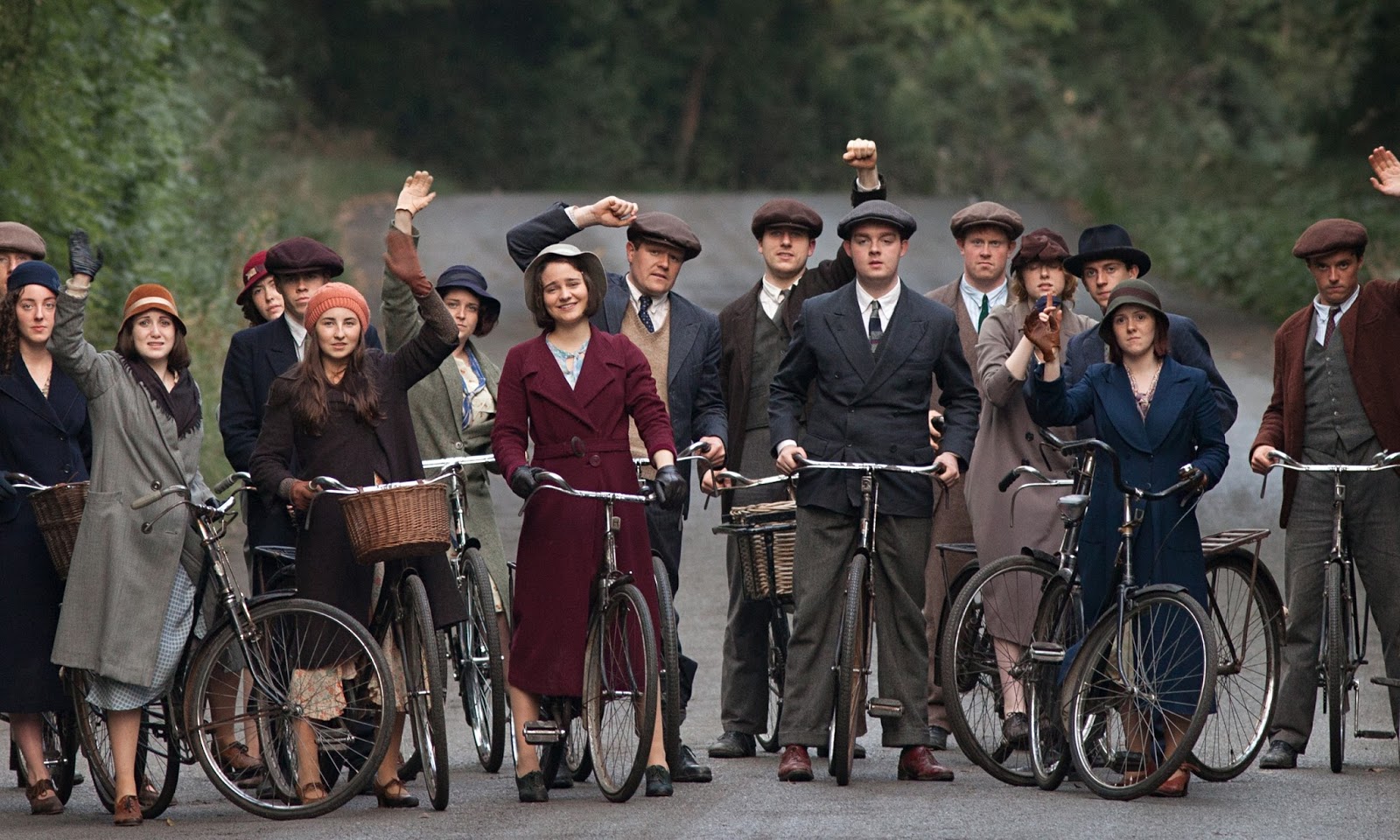
This is the story of a wonderful movie I just watched at Laemmle Cinemas: "Jimmy's Hall."  This movie is based on a true story from Ireland in the thirties.  I am telling this story to show one small example of what the ruling class and the church could do in order to stay in power.  Is there any justice or compassion in this story?
These are highlights of the true story: In 1933, Jimmy Gralton, as he was known locally, became the only Irish citizen ever to have been deported from the country when he was forcefully removed and put on a boat to America. He would never set foot in his native land again.
Such severe punishment for his ‘crimes’ seems improbable 81 years on. A dissident voice, Gralton was victimized by the political and religious establishment after daring to establish a dance hall in rural Ireland. A self-educated, community-serving man, Gralton’s hall was built to serve as a venue for the local people of Leitrim.

The youth in the village begging Jimmy to reopen his Hall.
Community dances, singing lessons, poetry appreciation sessions, boxing classes, and debates about workers’ rights were held there. It sounds innocuous. But for the Catholic Church and the Irish ruling class, the hall and the man who built it represented something dangerous and subversive — the fact that the people were beginning to think and act for themselves.


Jimmy and the orchestra


The movie clearly visualizes the story: The church continuously sabotaged Jimmy’s group.  Jimmy’s Hall was burned twice.  When the police came to deport him, his lovely old mother said: “What did I do?  I just gave him books!?”  The lady was running a mobile library.
I think all religions are guilty of ruling societies based on ignorance.  They are stuck in the ideas of tradition and orthodoxy.
I see no other way but for all religions to modernize.  We need to accept the fact that people should be educated.  That knowledge is accessible to all.  That women are equal to men.
Jimmy was talking about jazz and dancing with black people in NY.  "They actually have two legs!!"  I advocate separation of state and religion in Israel.  Although I know that the religious establishment has control over many of the personal laws.  This is despite the fact that 60% of the citizens would like the freedom in making their choices.
The Catholics have the most change to go through.  I know I am very naïve, but there needs to be an end celibacy for priests.  I read that the whole practice came about because they didn't want any land belonging to the church to be divided among the heirs.  This was pointed out clearly in Dan Brown's best seller The Da Vinci Code.
I cannot say how Islam is going to adapt to these modern times of every kid holding a cell phone with knowledge and information right at the tip of their fingers.  But I truly wish to see more justice and equality. 
I’d like to hear more voices like Jimmy’s for progressive politics.  For allowing people to use their creativity and imagination to paint and sing and dance.
Jimmy Gralton represented that alternative voice and finding a space for dissidents — and also seeing them as important alternative arguments — is a major question of our time.

Thursday, July 9, 2015

Highlights from the Neues Museum, Berlin


I had two goals when I visited the Neues Museum in Berlin.
The first was to see the bust of Nefertiti, who is considered the most beautiful ever:


She is presented in a glass case and I could walk around and appreciate the perfect features.

The second item was upstairs and was very surprising: The Gold Hat:
מצנפת זהב


The gold hat is a Late Bronze Age 1000- 800 BC artefact made of thin gold leaf. It served as the external covering on a long conical brimmed headdress, probably of an organic material.  Modern scholarship has demonstrated that the ornamentation of the gold leaf cones represent systematic sequences in terms of number and types of ornaments per band. The object would have permitted the determination of dates or periods in both lunar and solar calendars.


Only four of these hats were found and this was the most preserved.


Balance of Freedom and Obedience

We all wish for freedom in some way. When growing up we need freedoms but some discipline is required.  Women flourish when given freedom to pursue their dreams and goals, yet in many cultures they are still forced to submission.  Free societies have more freedoms for their citizens to achieve their dreams and goals, compared with authoritative governments that insist on keeping centralized power and no freedom to the “small people.”
Children like to run around free, explore and imagine. Yet many parents think it important to discipline them: Sit straight!  Don’t speak with food in your mouth!  I find that kids become better adults when they are exposed to many experiences and are given the choices to do the things that ignite their imagination.  The balance of this is to teach some “manners”.  Basically kids need to learn to appreciate other kids and never fear that they would be discriminated against.
Women don’t have any basic rights in so many places in the world.  Even in the Western democracies women had to fight for their right to vote and it took a long process to grant them this right.  Equality is a right that we have to fight for continuously.  I’d like to bring here two extreme examples for women’s equality: Sharol Sandberg, one of the most successful women in social media: married, pregnant.  Sadly she lost her husband.  This is a woman at her best: Shining, active, a role model for many young girls.


Then you can look at this photo of young girls being sold as slaves by ISIS.


In 2015 some men believe that going back to the days of the caliphate is an ideal to strive for.  There are also many other women with no rights and no freedoms: women in India born into “generational prostitution,” and other examples you can watch in the documentary “Half the Sky.”
I believe we would all be better off if young girls would get a similar education to men everywhere.  If they were allowed basic freedoms and given their own choices they would be able to contribute so much more to our lives.  They would be raising the next generation of children the same way: freely encouraging imagination and creativity.
Freedom comes with responsibility. Freedom cannot be guaranteed if people do as they please without considering the consequences.  I will try and address this in a future post.


Thursday, June 25, 2015

The Israeli in Berlin

This is the story of my two weeks visit and impressions of Berlin.  I had the opportunity to visit with my old time friend from high school and I was curious how I would feel there.
I had no preconceived notions of this city.  Among my Israeli and Jewish friends there are those who absolutely love Berlin.  And there are those who get completely upset about the very idea of going there.  "Just the sound of the German language makes me shudder!"  
Many Israelis made their home in Berlin, which seems to be some kind of irony.  They like it because of the low cost of living, the atmosphere of art and culture, the relaxed way of life.  I'd like to mention the one thing that is common to EVERY Israeli, it is the Hebrew language.  Hebrew as Ivrit עברית from the root word of crossing over.  Many confuse Hebrew with Jewish or Israeli language.  Other than this language Israelis are all so different: They can be from the east or the west. They can have faith in the Torah and the word god or they can be completely secular.  Yes, it is possible to be a Jewish Israeli and have no faith.  They can be on the right or the left of the political spectrum.  They can be academic or working folks.  If you come to Berlin in the summer they say the second most spoken language here is Hebrew.  And you will find Israelis who come to shop at the all new Berlin Mall.  You may meet Israelis who take a boat ride on the river or go on one of the many guided tours in Hebrew.
Israelis can spot each other just by the sound of one word like shalom.  Five minutes later they will know the family history, what made them come to Berlin, how long they are staying, how many grandkids they have and how much they paid for the shoes for those grandkids.
Nadav was the tour guide on the day trip I took to Dresden.  He came to Berlin to do his PhD on "How democracies deal with terrorism."  He never completed his dissertation, but he now runs the "Insider Tours Berlin" with over 40 Israeli employees and guided tours in Hebrew as well as English.  They all made their home in Berlin and speak fluent German as well.  They have the knowledge and the passion for telling the history of this city: From the atrocities and terror of war to the decades of a city divided by a wall.
http://www.insidertour.com/
My seat mate on the bus to Dresden was Rakefet.  She is spending a year in Berlin with her husband who is working on his Post Doc in history.  They are "modern orthodox" observe the Sabbath and keep kosher.  Their two teenage boys go to a "yeshiva" with only 60 kids in the whole school.  Rakefet is very pleased with the general curriculum of the yeshiva with excellent teachers in all disciplines.  She is also taking lessons in German and can live with the idea that they may stay in Berlin.
The most colorful Israeli I met in Berlin was Haim with the elaborate beard.  He greeted us at the Museum Blinderkerstatt Otto Weidt.  I had to ask him about the meaning of his beard and he happily posed for a photo and told me the whole tale.


Leaving Berlin I had a better understanding of the city.  But I am still not sure if these people are unique in their behavior or we could all follow a similar fate.