Friday, January 3, 2020

Why Madagascar


This is the story of the most exciting trip I ever took in my life.  It was my trip to the Islands of the Indian Ocean during seventeen days from late November to early December 2019.  Many people I have known are world travelers and they are either on a trip or planning their next trip.  But so far, I never met anyone who traveled to Madagascar. 
It was a quick, easy decision to make.  As soon as I received the email from my friend Irit, including the trip itinerary, asking me if I would like to join her, I immediately knew this was my trip.  During the six months that we were planning the trip, many people were asking me: Why Madagascar?  This was a strange question, as in my mind the answer was obvious: I could not think of a more exciting place to go visit! First, I don’t know much about it, and no one ever talked about going there.  So sure, I’d like to go find out!
Irit happened to know the specific guide for this tour, who she met on a previous trip to Morocco.  It was advertised on an Israeli tour company website, and I would like to say that I have been to many tours with Israeli guides, and they are usually very knowledgeable and give you a thorough explanation of a place’s history, geography, nature and culture.
I would start with a brief description of the itinerary:
We flew from Israel to Rome then to Mauritius.  From Mauritius we boarded the Italian cruise ship Costa Mediteranea.  We were 28 Israelis among some two thousand passengers on the ship.  We sailed to the Seychelles and visited the largest island Mahé, with the capital city Victoria, and then two smaller islands, Praslin and La Digue.  We then sailed to Madagascar, where we docked at three different ports at the north part of the island: Diego Suarez, Nosy Komba and Toamasina.  Our next port was San Demi, Reunion Island.  And then we sailed back where we started at Mauritius. 
All these places and names did not mean much to me before.  But after this trip I gathered so many facts and experiences, that I feel so much more enriched!  I very vaguely remember the geography lesson from high school telling us about the super continent Pangaea. The great reality for me was that here I witnessed the result of that old super continent Pangaea breaking apart over a hundred eighty million years ago.  India broke away from Africa and pushed toward Asia, creating the Himalaya Mountains.  Madagascar separated from Africa and was the largest island in the Indian Ocean.  All the other islands were the mountain tops of the old super continent.  I learned that these islands we visited, each had a different geological age, with the youngest still having an active volcano.  That was Reunion Island aged a mere 65 million years.  I also witnessed the endemic forms of animals and plants specific to these islands as they were isolated from all other continents.
The cultural lectures by the resident scholar on the ship, who explained the history, nature and culture of each island, were supplemented by our guide Yaron, the zoologist.  He walked us through the botanic gardens, museums and bazaars and enriched our knowledge of the people and their ways of life.  On each island we also had a local tour guide, who organized our delicious group lunch and told us many interesting personal stories. 
At the Seychelles our local guide Steve was an employee of the tour company 7 degrees south.  He told us that the owner of the company was a French lady who married a local guy.  She named the company after the location of her office south of the equator.

Our ship was docked at Mahé.  We traveled in every possible means of transportation from island to island.  From Mahé we rode a catamaran to the next Island Praslin. Then a boat to La Digue, then we rode on trucks to the restaurant which was set up on a wooden platform under a makeshift metal roof.  Lunch included delicious vegetables and some fish.  We were surprised by a sudden pouring rain that created a huge noise on the roof.  We struggled through the rain to watch the tortoises enclosed nearby.
Next, we spent a day in Mahé.  We saw many trees typical to this tropical hot and humid weather:  we learned to recognize the coconut, cacao, mango and many other trees.  I most enjoyed the visit to the botanic gardens named Baie Lazare.  I loved all the unusual plants: Crepe and Alpinia Ginger, Carambola (star fruit,) elephant apple, water apples, Mahogany tree from Honduras.  I enjoyed even more our visit to the 25 Acre spice farm, Jardin Du Roi: Stick insect, Bread nut, Mace, nutmeg, cinnamon, black pepper and more. 
I had an amazing wonderful surprise at the three ports in Madagascar.  The best part in these ports were the welcoming group of colorful singers and dancers greeting us just as we disembarked the ship.  We first saw them in Nosy Be, a group of beautiful ladies dressed in long dresses of bright white-yellow-orange, their dark faces painted with yellow flowers, singing and dancing for us to the beat of the drummers.  The beat was very fast with complex African rhythms, that made me want to jump in and happily dance with them.

Next port was Antsiranana, we heard the singing to the beat of go-go-go, fast, loud and very catchy, then we saw the line of singers in white and bright pink T shirts.  The musicians were sitting by the shade of a structure, wearing the same T shirts but with added green flowery skirts, beating on various drums.  Their dark faces beautiful and smiling happily.  Some of us naturally joined the dancers and moved to the special beat of their drums. 


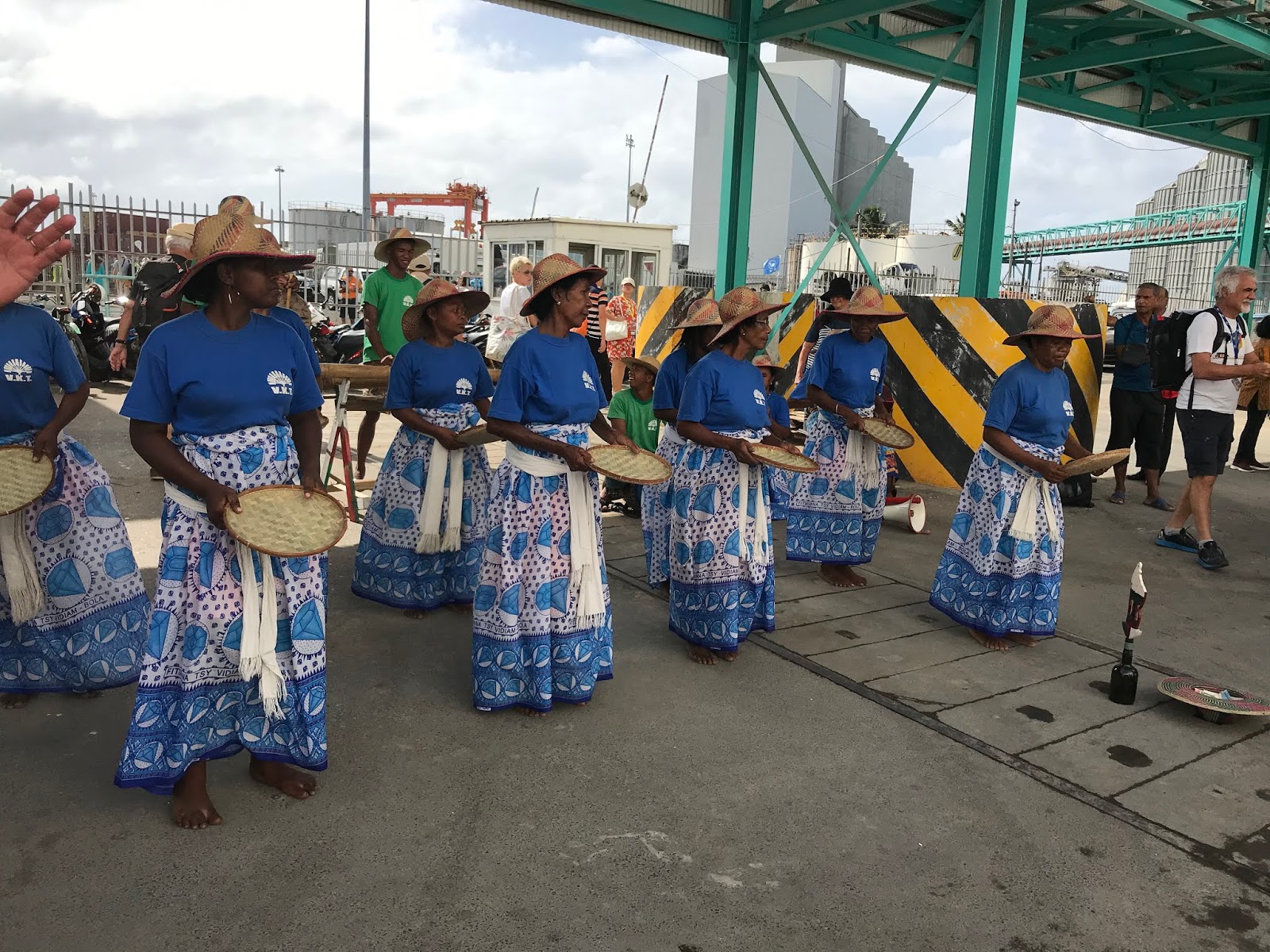
At the third port in Tamatave, the dancers greeting us were wearing blue shirts, white and blue long flowery skirts, straw hats on their heads and in their hands, they were holding straw baskets moving them from side to side to the beat of the drums.


These beautiful images and sounds of the dancers and musicians stayed in my mind and left a strong unforgettable feeling of happiness.  These people were poor, they never had fancy houses or electrical appliances.  Yet they were so satisfied with their lot.  They always had plenty of food with fruits falling from the trees everywhere, and fish from the ocean.  Their faces were kind and forever smiling.  I was filled with this great mixture of colors and sounds and facial expressions from a place so exotic.  I was full of gratitude to Irit for making this trip a reality.
I learned all the historical facts about these islands.  There were many visitors and conquerors, first the Arabs, then the Portuguese, the French, the English.  Most islands were now independent, except La Reunion which remained as the 21st district of France. 
I also learned about their economy, which was based on agriculture and products of sugar cane and various spices.  We visited a Vanilla farm and a Rum factory.  Recently they all benefit from high end tourism, as well as call centers.
I also enjoyed the company of my fellow travelers in the group.  We had plenty of chances to interact and get to know each other.  Each had his own contribution to the experience of these amazing places in the Indian Ocean.  The blue color of the ocean and the smiling faces of my friends and the locals will stay in my mind for a long time.
I returned home and stayed in a high mood for weeks.  I was very pleased about my choice to visit Madagascar and neighboring islands.  Some of my friends were still asking me: Why did you chose to go to Madagascar?  I hope I gave a good answer.


Sunday, July 14, 2019

The Trees This Summer


We had so much rain
This past winter
My neighborhood was wet
for many long months
The trees were all bare.
Looking up at them
I was awed by the intricate
Structure of the branches
Filling up an almost round space.
Spring came and I saw
Flowers budding on the bare branches
One little magnolia
Had the biggest pink flowers

Slowly green leaves appeared
Leaves and more leaves
All the trees everywhere
Are greener than I ever remember
The canopies of the trees
Are tall and proud
The poplar next to my house
Amazed me with its beauty

On the magnolia around the corner
Big white flowers showed up
Astonishing and so beautiful
That I had to write this!


Tuesday, April 30, 2019

About Me

I am reposting my original essay when I started this blog.

My writing is coming from my life experiences.  I care about the future of the world.  I care about people and I believe our planet can support us all in peaceful productive lives.  If I was a preacher, I would preach for knowledge, science and art, imagination and music.  I would preach for respecting all traditions but against ignorance.
Here are the highlights of my life story:
The Jews of Mashhad were forced to practice Islam for one hundred and fifty years. They kept their Judaic traditions in hiding.  My parents were married in Mashhad then moved to Tehran where I was born.  In 1951 the entire family immigrated to Israel. The Mashhadi community in Israel kept their specific traditions for decades throughout the world: New York, London, Milan.
I was a quiet shy girl always curious and studious.  I excelled in school and were fascinated by the laws of nature as early as second grade.  Growing up in Tel Aviv we lived with both my grandparents and three uncles in one small house for eight years.  I started reading books when my uncle bought his first set of books.  My high school teachers were the ones who guided me throughout my studies and ultimately my future career as a research biochemist.  I married a man from California who had a similar background of the Mashhadi community.  We raised our two sons in California, while our respective parents had the continuous influence of keeping the Mashhadi traditions. To this day I am the only scientist in my extended family.
This is the story of my journey from the Jews of Mashhad to the study of protein chemistry.   Proteins that pump acid into your stomach, balance sodium and potassium in your kidneys, proteins that control your metabolism and proteins that turn into amyloids and cause neuro-degenerative diseases.

Friday, March 22, 2019

Tree Pose


TREE POSE

A sunny day in yoga class

The room is flooded with sunshine

Two skylights in the ceiling

Which is lined in colorful clothes

Red yellow pink and orange.


I am standing across from the teacher

Behind her a long narrow window

Through the window I see the street

The parked car next to a Camelia tree


Strengthen your right leg

and slowly lift your left leg

How long can I stand like this?

I lift my hands in prayer

I start to shake a little and

I strengthen my abdominal muscles

I gain some confidence

and I raise my arms as a tree


I strengthen my right leg again

My spine is straight

And I feel in a perfect balance

Almost as the tree.

Friday, February 1, 2019

From Russian Pogroms to Nobel Peace Prize


I had an amazing chain of events hearing and reading about the pogroms in Russia in the late 1890’s and early 1900. The stories were first so far away in time and place I could not quite relate to them. 
I wanted to talk to people about the pogroms, but many did not even hear the word. I googled the word:  it is a Russian word meaning total devastation. 

A few months ago, I read a book about Israel where the writer talked about a famous poem in each period of Jewish History. In 1905 the famous poem was: The City of Killing, by the poet H.N. Bialik. 

Bialik was a young journalist at the time of the Kishinev Pogrom. The town was attacked by hooligans who killed and raped and destroyed everything in their path.  Bialik was sent to the town to take testimonies and report on the event. He spoke to the women who were in shock, and to the men, some brave some cowards. In his poem he cries out about the rabbis who made the decree that the women who were raped were not allowed to their husbands. “What dark minded leaders are these?”  Cried Bialik. 

Sometime later I heard about a specific family who was affected by the Kishinev pogrom. This was a presentation about another Israeli poet who just passed away in his 90’s Haim Guri. His mother was always sad. The story was that as a young girl she watched her mother being raped. After that the mother was banned from the family. She used to come at nighttime and watch her children sleeping.  In the end she could not take it any longer, she walked to the river and never returned. This is a real story where the rape of one woman affects not just her but her children and grandchildren. 

This past year my friend recommended the book "The Last Girl," written by Nadia Murad. She is one of the young Yazidi women captured by ISIS.  These women became the slaves of ISIS warriors and were gang raped daily.  Nadia managed to escape, and she became a spokeswoman for molested girls everywhere.  She won the Nobel prize for peace this year together with Dr. Mukwege.  He is the gynecologist who healed the wounds of many women raped in the war in Congo.  In her book Nadia talks about the Yazidi leaders who pondered the fate of their raped women.  They were more enlightened than previous leaders and decreed that it was not the women’s fault, therefore these women are allowed back in society to lead a normal healthy life.

To end this story, I want to mention the biblical story I happened to read to my students: Joseph and his dreams.  Joseph serves at Potiphar's house the minister to Pharaoh and he does a great job.  He is very handsome, and Potiphar's wife tries to seduce him. He keeps runing away from her, but one time she manages to get hold of his clothing and tears away a piece.  When her husband comes home, she blames Joseph for attacking her and Joseph is sent to Jail.  It did not escape my young student that this is an early story of “he said she said.” 


Monday, December 17, 2018

Cleantech and the Battle Against Climate Change


When I received this email, I was wondering what is the connection between Tel Aviv University and the City of Beverly Hills?

I received an email from the office of Friends of Tel Aviv University inviting me to a symposium at Beverly Hills City Hall.  The topic was:

“Cleantech and the Battle Against Climate Change”.

The email stated: We have three amazing panelists, and a Pulitzer Prize winning journalist to moderate.  The symposium will be an in-depth exploration of the many challenges of climate change and the technologies and innovations being developed to tackle this planetary crisis.

A woman was welcoming me as I made my way to the hall and I asked her about this connection.  She told that the City of Beverly Hills has an agreement with the Israeli Consulate in Los Angeles to cooperate on environmental and business issues.

Julian Gold, the mayor of Beverly Hills opened the meeting.

The moderator Julie Cart was an environmental reporter for the Los Angeles Times. In 2009, Cart and colleague Bettina Boxall won the Pulitzer Prize for explanatory reporting.

Tel Aviv University was represented by Prof. Colin Price, head of TAU Porter School of Environmental Studies.  Colin lead a recent TAU study that suggests that weather patterns lead to flash floods may one day be tracked and anticipated by smart phones.


David Nahai was the CEO and Commission President of the Los Angeles Department of Water and Power, former Chairman of the Los Angeles Regional Water Quality Control.  Today he is President of David Nahai Consulting Services.


Aaron Tartakovsky is the co-founder and CEO of Epic CleanTec, a green technology startup redefining urban sanitation by converting building waste water into clean water and high-quality soil.


The panelists each introduced themselves and talked about their contributions from the academic, government and private sector point of view.  They mentioned EJ:  Environmental Justice. They talked about the crumbling infrastructure of utilities and the best way to repair them.  Is it possible to decentralize entrenched utilities?  We need to build small scale individual power supplies rather than repairing the crumbling infrastructure. 

Solar energy:  solar panels can provide extra power that could flow back to a grid. Part of the solution would be: Energy storage

Nahai predicts that we will have wireless charging soon. 

In the Q&A there was a discussion about the private sector and government regulations.  Clearly the solution is in the correct balance of necessary regulations and incentives for the private sector.

Seth M. Siegel was in the audience and he noted: In California we first need: Waste water and storm water capturing. He wrote the book on the subject: Let there be Water!  Israel’s Solution for a Water Starved World.

I highly recommend this book.  It starts with a time-line of all the innovations in Israel ensuring that the water resources in the region will be plentiful for the growing population.  It goes on to detail the stories of Netafim- drip irrigation, and the large desalination plants.

Saturday, December 15, 2018

Israel and Water with Booky Oren

 I am reposting this from March 2015, after I found out about the new book written on the subject: "Let There Be Water, Israel's Solution for a Water Starved World." by Seth M Siegel.

In February 2015 attended a lecture about Israel and water and learned much about the business side of water:

Israel and Water: Collaboration, Innovation, and Global Leadership”

Booky Oren, Chairman and CEO, Booky Oren Global Water Technologies


Booky Oren


Water shortages persist as a major issue all over the world. In 2013 however, Israel overcame its water challenges through implementing a variety of technological solutions, making 2013 Israel’s “Water Independence Year.” In this talk, Booky Oren will discuss Israel’s innovative water solutions and how they can be leveraged in a global context to create economic growth while also assisting billions of people worldwide.

Booky Oren is not an engineer but an MBA.

He started the talk with two maps of the Middle East.  One from space.  The second one the underground water flows.  In both maps there were no borders.

(Ahhh how many of us would like a world without borders...)

In 1912 the British calculated that the water resources in the area of the Palestine mandate can support a population of 2.5 million.  Today there are 14 million people living in the area.  I would like to stress our human ingenuity, the advances we made in science and technology.  I do not prescribe to any idea of shortages and lack of this or that.  It is in our power to bring abundance into our lives and that of our fellow humans.

Water has been used in war and in peace.  In 1967 Syria tried to block the water resources to Israel as part of their goals in the six day war.  In 1994 Israel signed a peace treaty with Jordan where they promise to provide Jordan with all their water needs.  2013 was marked as the year of water independence for Israel.

Booky Oren is interested in the commercial aspects of water.  He was CFO of Israeli companies such as Mekorot and Netafim.  He is now involved in i2i “Innovation to Implementation.”

He claims water technology can solve many problems around the world.  Like me he is convinced that there is plenty of water, there is abundance!  He has a global perspective and he pointed out that politicians are still using water for political gains.  They will keep the same old infrastructure and red tape in any possible way they can to slow down implementations of new technology.  If there is a drought in one place there is flood in other places so this is where we should allow our ingenuity to take over.  He brought the example of desalinations plants in Israel.  For years the budget did not include operation of these plants.  The year there was a drought the operation of the desalination plants was instantly funded.

Israel needs to leverage its technology for partnerships with water utility companies.

In closing the speaker pointed out a list of proven innovative global water technologies that can improve the sector:

Israel: ELTAV www.eltav.com, OUTLOCKS.

Switzerland: Gutermann. 

Canada: viva modeling

Spain: Aqualogy

Germany: HSTsystem

USA: FATHOM http://www.gwfathom.com/

UCLA: NORIA