Showing posts with label Education. Show all posts

Friday, May 25, 2018

Musings on Scenes from Westwood

A few days ago I was stopped at a red light in the corner of Sepulveda and Santa Monica Blvd in West Los Angeles. I noticed on my left across the four lanes of the boulevard an interesting man standing at the street corner. A tall upright man, dark skinned, dressed in a long black winter coat going down to his bare ankles. I seem to remember he was wearing black shoes.  A sleeping bag was spread in front of him on the pavement and nothing else. For a moment I thought he is one of the homeless people you see in this part of town. But as I was waiting for the red light to change I observed his rhythmic movements from side to side. And it looked like a beautiful dance. Was it a dance or was it a reaction to some drugs he injected?  I will not know the answer as the light changed and I was on my way to my writing group.
My hair dresser works in a Salon near the supermarket on Westwood Blvd. She is one of the Jewish immigrants who came to California from Iran in the eighties. She is an intelligent woman who used to work as a nurse. She is very warm and friendly and often wants to talk about what is going on in my life. I told her about my last visit in Amsterdam and my tour of the Portuguese Synagogue there. The synagogue was built in 1675 and still stands in the original architecture with no electricity. People continue to pray there until today. At nights they use candle light. It was built by Jews who were expelled from Spain and Portugal by the inquisition in the 15th century. I asked if she heard about this expulsion. She had No recollection.

Amsterdam's Portuguese Synagogue

At the Landmark Theater in Westwood they are now showing the movie RBG about the Supreme Court judge. She is the second woman in history that was nominated for the Supreme Court. I loved this movie and recommended it to my friends. You will be surprised to hear how many people in Westwood never heard of her. So I continue to ask them in the same line: Do you remember the French Revolution?  Liberty, Equality, brotherhood?
They remember nothing!
There was a homeless woman who sat at a street corner a few days. She was covered with old blankets and her dirty clothes were piled in a supermarket cart. I saw her once in the supermarket restrooms washing her long hair in the sink. What does she know of freedom and democracy? Maybe she once learned to dance in her youth?

Saturday, August 13, 2016

Meteor Showers and our Common Humanity


Have you ever seen a meteor shower?  I am sure you have heard of this amazing sight in the sky.
A meteor shower can be seen in the skies this August! 
Every time I hear about the vast space beyond us, I wonder why we happen to be on our small blue planet.  Why is this the one and only planet with the diverse amazing life forms in the whole wide universe that we can see beyond?


This is a photo of meteor showers taken from a telescope in the Negev, the southern part of Israel.


This photo is from the NASA website:

"In this 30 second exposure, a meteor streaks across the sky during the annual Perseid meteor shower Friday, Aug. 12, 2016 in Spruce Knob, West Virginia.
The Perseids show up every year in August when Earth ventures through trails of debris left behind by an ancient comet. This year, Earth may be in for a closer encounter than usual with the comet trails that result in meteor shower, setting the stage for a spectacular display."
Does anyone comprehend the terms "debris left behind by an ancient comet"?  Star dust?  I feel that these are real things that are much bigger than everything happening on our small planet.  
At the same time I read that many people on earth, those who live in large cities, as many as one third, never get to see the stars. Never get to see the night sky, or the milky way.
Just for comparison, I happened to attend an evening organised by the Daniel Pearl Foundation as Rob Eshman, Publisher and Editor-in-Chief TRIBE Media/Jewish Journal, lead an interactive dialogue with two Daniel Pearl Fellows: Amal Khan (2016 fellow), and Aoun Sahi (2010 fellow) journalists from Pakistan.
These two young Journalists presented an image of Pakistan that was different from what we hear in our media, or that I ever heard about.  They were surprised to find out the Americans are just as humans as their Pakistani families.  They stressed that in the eyes of the average Pakistani Americans are some kind of evil mutant of humanity.  They are fed mis-truths about Israel and "Jews" are so misunderstood, they are not even considered human.
The Pakistani's image of the west is mostly from popular TV programs: consumerism, lack of family values, etc.  
My question to Amal was: Is there any way that they can attempt to show science and nature programs on Pakistani TV?  Pakistani kids can certainly watch the night sky and witness the milky way.  As we all know kids have innate curiosity, and I am certain that watching a meteor shower will stimulate enough kids to comprehend that universe beyond.  Future generations should be taught basics of life and biology.  We cannot leave education up to politicians.
Aoun mentioned that they do not have enough teachers and educators to raise an informed future generation.  I'd like to suggest using the parts of the internet and TV media that is geared toward basic education: 
Websites like Kahnacademy.com
TV shows like Cosmos.
We have to begin somewhere in teaching common humanity rather than historic and political differences.


Wednesday, April 13, 2016

Basic Science #7: Albumin

Albumin is a large abundant protein in our blood.  When blood is collected in a tube and left to stand, the red cells, containing hemoglobin will sink to the bottom.  The liquid on top is called serum or plasma.   Albumin gives it the yellowish color.  Serum also contains various components important for our overall health.  The white blood cells and platelets will be in between these two layers - in the interphase.


We should all know about a blood test for Albumin (by my health care provider):
Normal amounts of Albumin: 3.3 - 4.8 g/dL. Albumin is a protein that is made in the liver and released into the blood. It helps keep the blood from leaking out of blood vessels. Albumin also helps carry some medicines and other substances through the blood and is important for tissue growth and healing.
Chemistry of albumin: Human serum albumin - HSA is made of 609 amino acids.  (Yes six hundred and nine amino acids!)  Bovine serum albumin - BSA has a very similar chemistry with small differences in amino acid sequence.   Here is the 3D structure of both proteins pointing out this specific difference:

Human and Bovine Serum Albumin:


The similar structure of albumin in various organisms can be followed from lower organisms to higher ones.  This is the scientific base of evolution.  In comparative genetics the scientists can compare the amino acid sequence of mouse, rat, dog, bovine and human and show the homology.  There is a higher fit or homology between human and bovine, than between human and mouse.
Albumins belong to a group of proteins described as globular proteins, referring to their spherical shape.  This shape makes them soluble in water, so their location in the cell is in the aqueous, or water environment.  Some proteins are membrane proteins which means they are not soluble in water and will be attached to the cell wall or membrane. 
An important aspect of biochemistry of proteins is transport of nutrients or drugs depending on their solubility in water.  Albumin has an important role as a “universal” solvent.  Here you can see how Albumin can attach various molecules as fatty acids which are lipids, or calcium which is a small ion, and transfer them through the blood to their destination in the body.


Albumin attached to various drugs and nutrients:


In this post on Albumin I have introduced the principles of soluble and membrane proteins and some basis of evolution. I hope more people would study these topics and learn to appreciate our amazing complex biology.

Thursday, March 10, 2016

Basic Science #6: Hemoglobin

Hemoglobin was the first protein that we studied in biochemistry.  I have great fondness for this protein. 
Before I start talking about the chemistry of hemoglobin you should remember a few facts:
*Everybody knows this important protein in our blood. 
*It gives blood the red color because it contains an iron ion. 
*It is essential for binding oxygen and so it gives us energy. 
*Levels of hemoglobin in the blood are measured in any standard blood test. 
*Hemoglobin levels are higher in men than in women and that is one reason why men are usually stronger.
*Hemoglobin levels correlate with the number of red blood cells and levels of iron.  If hemoglobin levels are low it is often caused by iron deficiency anemia.
*The part of the protein that contains iron is called heme.
As I was studying the biology of proteins one fact always amazed me.  My childish impression was that the protein was made once and stayed like that.  But I found out that our cells are continuously making and breaking the proteins according to their need in the machinery of the cell.  If your cell needs the energy it will make more hemoglobin.  While you rest it will break down the protein to its individual amino acids.  And both these processes are very finely controlled.  It is amazing how super intelligent our cells are.

Chemistry of hemoglobin.

Check out this 3D model of hemoglobin:


Hemoglobin is made of 564 amino acids.  Molecular weight of hemoglobin is around 50,000 (For comparison: Oxygen molecule is 16, it fits in a small pocket of hemoglobin.)
Now try to imagine how these 564 amino acids fold in the cell to make the two subunits: a and b. These two subunits then double up to form a tetramer with two of each subunit.  Then the heme is inserted in each of the four subunits for a fully active protein enabling the special function of the hemoglobin - the transfer of the oxygen.  An alteration of any part of this structure of hemoglobin would cause inability to execute its duty of carrying oxygen.
I was really amazed to learn how complex is the structure of such an important basic protein.  The more I learn about the mechanism of action of proteins in our biology I am stunned to see the intricacy of it all.  

To add to the complexity of this we now measure levels of hemoglobin a1c in diabetes patients.  The high level of glucose molecules in the blood causes them to attach to the hemoglobin to form glycated hemoglobin:


I am thankful every day for the way my cells allow me to continue breathing and thinking, running and dancing!

Tuesday, March 1, 2016

Political Balance in a Democracy

We hear about the phenomenon of Donald Trump having such an unstoppable run to become a Republican candidate for president of the United States. Two of my good intelligent friends told me they will vote for him as they are staunch republicans. It is the kind of people who say anything is better than Hillary, or Obama was the worst thing that happened in the USA.   
One of these friends told me: "Sara, there is no justice there never was and there never will be justice." This may be true but it does not stop me from striving for justice, truth, knowledge. 
We are all proud to be part of the American democracy. How do we improve it?  I want to present some of my ideas of finding balance in our divided politics. 
People will tell you that capitalism is the reason for the economic success of this country. I can show you here where pure capitalism fails. By pure capitalism I mean judging every move by the immediate monetary returns. What is lacking in this policy is a long term vision of the economy and welfare of the citizens. Here are a few examples of where we can improve. 
Nutrition: We have large successful food companies that provide us with fully stacked supermarket shelves. There is no lack of food or malnutrition like in many other places in the world. The downside is that in order to maximize shelf life and so profits the packaged food is loaded with sugar, fat and salt. No one suspected that there is anything wrong with this. No one thought that we are losing balance here. There is over nutrition that our physiology is not equipped with defense mechanisms against it. So we have to deal with epidemic levels of high blood pressure, obesity, cancer. To find balance the food industries should have a minimum degree of social responsibility
Education: I am so lucky to have gotten my education for free back in 1960’s Israel!  Today in the US most people need to get college loans to complete their education and they are burdened with heavy debts when they start their career.  I am even hearing this idea that we do not have enough teachers and universities to give a college education to all.  This idea is completely out of balance.  We can put more people to work building more universities!  There is nothing as important and essential as passing knowledge to future generations.  Again: we need a long term policy!  In addition we now have the internet with an ever growing number of educational websites for every learning disability imaginable.  There is no reason whatsoever that anyone who wants to learn cannot learn!
Clean water and air:  For a balanced political policy clean air and water are essential.  The people who claim it is too expensive to switch from oil to solar energy have no long term vision.  There is abundance of water in the world.  We need all the bright brains to have the knowledge to develop better ways to deliver clean water to as many people as possible.
Health care: A viable democracy requires a healthy knowledgeable electorate.  I had many arguments with those who oppose affordable health care for all.  The last of their points was that we do not have enough doctors and hospitals to care for everyone.  Again there is no long term vision here.  Why did we get to this place?  Why can't we train more doctors?  Why can’t we put people to work building more hospitals? 
I believe in balance between conservative and liberal ideas, tradition and progress.  But if we have an uneducated poor electorate with no affordable health care, why are we surprised that Donald Trump is so ahead in the polls?  We now have citizens with limited education and questionable health overwhelmingly voting for Donald Trump. I wonder if they learned in school about the rise of Hitler. 


Monday, January 4, 2016

Basic Science #2: Acids and Bases

Thanks to my readers who responded with interest to my basic science post.  Someone asked if the next element is going to be nitrogen?
I am now suggesting this order: we first talk about hydrogen then water then acids and bases.  Next nitrogen, ammonia carbon dioxide.  Then amino acids.
Hydrogen is element number 1.  One proton one electron.  The most abundant element on our planet. Oxygen is element number 8.  Oxygen is what we inhale and is essential for our survival.
These two elements give us WATER which is also essential for our survival.  H2O.
 
The water molecules has two ions in equilibrium: H+ proton and OH- hydroxyl:

When the amount of protons and hydroxyls is equal the pH is neutral, or pH=7.
When the protons are in a higher concentrations, then the pH is acidic.  Examples: When we eat acid is pumped into our stomachs to a pH as low as ONE in order to digest the food.
Vinegar and lemon juice are also acidic.  Interesting to note here that the Hebrew word for acid comes from the rood that means sour.  Any foods with a sour taste are acidic.
When the hydroxyl ion is in high concentrations the pH is basic.  Examples are baking soda and drain cleaners.  Bases usually taste bitter.
 
Now we are ready to talk about nitrogen.  Element number 7.  Nitrogen interacts with hydrogen to form ammonia: NH3. 
 
 
 Ammonia has a bad smell.  When dissolved in water ammonia will become basic:


Everyone is familiar with carbon dioxide CO2.
CO2 in water:
 Yes, this will be slightly acidic.

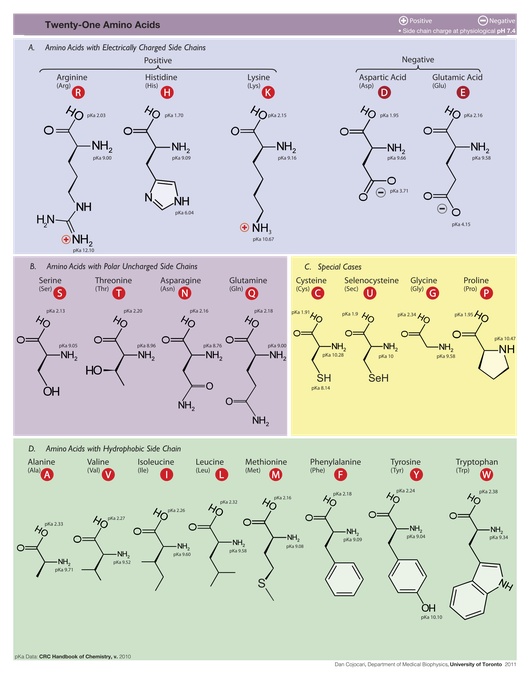
Now we are ready to understand what is an amino acid.  Amino acids are the building blocks of proteins in our food and in our bodies.  There are 22 amino acids in life. 
A simple amino acid is alanine:
The amine group is in blue.  The red group is the organic acid COOH.

Here is a chart of the various amino acids categorized by their chemical structure:

 http://rosalind.info/media/amino_acid_table.png

 Hope this post will help those who want to understand better.


Wednesday, December 23, 2015

Basic Science #1 Carbon Chemistry

I hope to write a series of posts on basic science, retelling the most memorable lessons in my life.  Basic science is the a discipline that combines all areas of mathematics with physics, chemistry and biology on the most theoretical level.  Not necessarily any immediate applications.  But the beauty of basic science is that it is universal and basically the truth.
This first lesson was in my senior year in high school, introduction to organic chemistry.  In the two previous years of chemistry studies I basically knew about the periodic table of elements like hydrogen, helium, carbon, nitrogen, oxygen and so on. Nothing was standing out as exciting or amazing.
Organic chemistry is basically the chemistry of carbon.  Carbon is the basic element in all of life.  It is in the backbone of sugars, proteins and fats.  What is special about carbon?  Carbon has 4 electrons in its outer shell, so it can share these equally with another element by creating a bond that is represented either as two dots or a line.
The interesting thing about carbon is the diversity of the compounds that it can be found in.  In this lesson we learned about two substances made of only carbon:  Diamond and graphite:
Diamond is the hardest substance and graphite is soft and powdery.  The memorable phrase was: "Vive la petite difference!"  (Doesn't sound as nice in English: long live the difference.)


You can see there are only carbons in these two substances.  In diamond each carbon is connected to four other carbons making perfect 60 degrees angles equally distanced in space.  This perfect crystal structure gives it the hard quality.
In graphite the angles are not all the same, there are flat layers of carbons attached in strong bonds, connected to layers above and below attached in much weaker bonds that cause this substance to be powdery.


This lesson is unforgettable.  It taught me the importance of geometry in studying chemistry and biology.  It clarified the stick and ball models used to describe and predict the structure and activity of molecules in nature and in life.


Monday, November 9, 2015

Interfaith Solutions for the Secular Minds


How do we bring more understanding among people from different parts of the world and opposing traditions?  I have already stressed the importance of knowledge and understanding our physical world.  I believe empowering women is also essential for progress of humanity as I have already spoken about women.
This time I want to talk about traditions, rituals, and faith.  I have been watching people closely, hearing many stories and reading a lot.
I can see that some people need rituals and some have no need for it at all.  I know many Jewish or Christians families where one brother lives his life going to weekly services, feels great about bowing down, waving different kinds of wands or a brush, and following age old traditions.  These are traditions that "have passed the test of time" as they say.
At the same time, a second brother in the same family laughs at the whole thing.  This brother has no need for any rituals.  The tradition has no magical or spiritual power over him. 
In the old world the community leaders would frown upon this second brother.   They would call him to a meeting and question his absences.  Even worse, there would be an internal police to spy on the activities of such people and shame them in public. But in recent times this brother happily stays away from rituals.  He stays home to read a book or go to a football game, a hike in the mountains, a surf in the ocean. 
In the old world large resources of the community would go into building massive lavish cathedrals or mosques or monasteries.  The rituals and ceremonies would be enhanced by the beauty of the structure and this would be the main meeting place for the community.
So we have two brothers, the traditionalist and the rebel.  In the wider world this creates a serious conflict between the "faithful" and the secular.
In Europe many of these lavish cathedrals are losing their grandeur as more and more of the young generations do not find the rituals comforting or necessary.  These young people are asking for a replacement of the churches as community centers and meeting places.  As I was pondering this sort of news for many years I heard this article on NPR about a 19th century church in Bolton, England that was abandoned.  Then it was bought by the local Muslim community and everyone was wondering if it would turn into a mosque.  But it was turned into a secular community center.  “Now, amid stories about religious friction and ethnic tensions, the transformation of All Souls Church provides a story of harmony and integration in one culturally diverse community.”
The Old:
Here is the article in the Guardian:
In the remodeled building there are now “halls for clubs and hobby groups, a garden for a local grow-your-own project, a concert space and a business and training center for local startups.”
 
The New:
This is the kind of solution that I feel will bring people together, will help cohesion and integration.  People will focus on their similar interests and common goals rather than stressing their differences.  Both brothers, the faithful and the rebel will belong here.


Thursday, October 22, 2015

The Importance of Knowledge for All


Our world is getting more and more complex every day and we need people with knowledge to tackle this complexity and help us solve problems.  Progress is inevitable and educating the young generations is essential in meeting the needs for this progress to continue improving our lives.  We now have the amazing internet with unimaginable power to increase our knowledge and at the same time to destroy us.  We need creative knowledgeable people to deal with cyber security and complex economies.  We need clever specialists to help with curing diseases and understanding behavior.
In the past most exceptional minds came from families with privileged means.  But nevertheless there were those young curious minds from very poor families that did manage to learn to read, get access to books and make their way to meet the right people and come up with great discoveries.
It is most important that every child around the world has access to knowledge and proper education.  Nobody knows when and where the most brilliant mind will appear.  Those rare brilliant minds may have the ability to solve problems that seem unsurmountable to many of us.
I have to stress here that progress is necessary to make sure the earth can sustain us all in peaceful productive life.  And we should all agree on this.  History shows us that sometimes people believe that “ignorance is bliss”.  Many rulers and autocrats denied people access to books and any kind of knowledge.  How often did governments burn books or ban them?  It was easier to control ignorant people I assume.
I came across a study by the National Science Foundation (NSF).  Questioning 2200 people they found that: 1 in 4 Americans Don't Know Earth Orbits the Sun. Yes, Really, in the United States.  Can you believe people are certain that the sun orbits the earth?
 
You can imagine the level of knowledge of the simple fact that the earth orbits the sun around the world in less developed countries.  There are places where there is no mandatory education.  Places where girls are not allowed to go to school.  I am with Malala: The pen is mightier than the sword.
I am optimistic about the power of the internet in bringing basic knowledge to masses of young children.  There are already programs like Kahn Academy with lesson plans in many basic areas as well as advanced topics.
Here is the opening statement from a the learning site:

You’ve probably heard the old quote, “Knowledge is Power,” That’s truer than you can ever imagine. Few people understand how important knowledge can be. Knowledge is what allows us to drive cars instead of ride horses, it is what helps us survive far longer than we should, and knowledge is even what prevents us from making the same mistakes we made in the past.

Lets obliterate ignorance!


Monday, October 12, 2015

When Knowledge Conquers Fear


I believe that knowledge is most important in bringing understanding and cooperation in our world.  The more I look at conflicts and disagreements the more convinced I am that knowledge and only with knowledge we can solve the many problems in our world.
The question is what is important to know?  I think it is important to understand the physical powers in our world.  It is important to know the basic tools that scientists and historians used to research different phenomena in our lives. 
This idea is very well explained in the TV series “Cosmos- A Spacetime Odyssey” narrated by the astrophysicist Neil deGrasse Tyson.  In the episode “When Knowledge Conquers Fear” it is shown how people were so afraid of floods and droughts and invented all sorts of gods and superstitions to overcome this fear.

Worshipping of Egyptian Bull God.
 
"The episode begins with Tyson describing how we were born into this world without an explanation of our surroundings, much like a baby abandoned on a doorstep. To help us learn about our surroundings, Tyson explains how we manifested pattern recognition early in mankind, sharpening over eons of evolution. We distinguished predator from prey; poisonous plants from nourishing ones - enhancing our chance to live and reproduce, and passing on our genes. We used pattern recognition in astronomy and astrology, where different cultures, recognizing the patterns of stars in the skies, projected different symbols and pictures for constellations. We used it to predict the passing of the seasons, including how every culture determined that the passage of a comet was taken as an omen. Tyson continues to explain that the origin of comets only became known in the 20th century.
Tyson then continues to relate the collaboration Edmund Halley and Isaac Newton in the last part of the 17th century. The collaboration would result in the publication of Philosophiæ Naturalis Principia Mathematica, the first major work to describe the laws of physics in mathematical terms, challenging the prevailing notion that God had planned out the heavens. Tyson explains how Newton's work would influence many factors of life, including modern space flight. Tyson further describes Halley's contributions including determining Earth's distance to the sun, the motion of stars and predicting of the orbit of the then-unnamed Halley's comet using Newton's laws. Tyson contrasts these scientific approaches to understanding the galaxy compared to what early mankind had done."
Isaac Newton and his historical publication of the mathematical principles
to describe  the movements of the planets in the universe.
 
Modern day archeologists find plenty of evidence on early humans, studying their bones and teeth and recently even DNA.  Physicists are conducting amazing experiments in the hydron collider to understand the very first event that caused the creation of our universe.  But the more we know, the more we find out there are more mysteries to unravel.  It is up to the most curious brilliant minds to figure out how to prevent diseases from a simple cold to mental illness.  Why do we face so many genocides in each generation?    We all want peaceful lives.  Why do we still have wars?  Some brilliant psychologists will come next and unravel the mysteries of our behavior.  Why is our planet heating up?  We are trying to convince people in power that it is up to us to stop this global warming.
I think the old traditions of faith in god and systems of ethical code of behavior are extremely important in our evolution.  But I cannot see how one faith will declare itself as the ultimate true faith and thus dismiss all the others.  The main goal is for all to understand that the earth can sustain us all and we should use our collective intelligence to cooperate and live in peacefull coexistence.
Know, understand and never fear!


Friday, September 11, 2015

Teaching Math to Girls and Women in Science


Do
boys and girls have different skills and ability to excel in mathematics? 
Most people will intuitively think that boys do better in math than girls.


I
heard an interesting review on NPR describing a study where they had math tests
checked by two sets of teachers.  The first set knew who wrote the test,
and the second set of teachers had no such knowledge so they had no idea if the
test was taken by a boy or a girl.  The surprising result was that the
teachers who did not know who took the test gave the girls a higher
score!!  This means that the first set of teachers had no expectation that
the girls can do well in math and therefore gave them a lower score regardless
of the answer.  Another study came to the
same conclusion:  Gender math gap is cultural not biological:


This
is not surprising to me, although as a very shy girl I did excel in math. To
this day I believe that understanding math is essential to any scientific field
and ultimately mathematics holds the answers to all the basic questions of our
existence.  But when I try to convey this to people, I mostly get utter
disinterest. I do not detect any excitement in people about knowledge, or
appreciation of deeper understanding of the biological and physical world
around us and even more so among women.  No wonder that with no
expectations, girls would not even try to grasp any basic concepts of math and
sciences. I find this very regretful.


Thinking
about women in science today, we have to remember that there were practically
no women scientists until the twentieth century. It is only in the past hundred
years that women began to have some equality with men.  We have only just begun to face the
intellectual and physical challenges of this equality. 
 
These
are some stories I heard from senior career women I was fortunate to work
with.  The late Doctor Jo Anne Brasel, a pediatrician at LABiomed had many
stories of her days at medical school as the only woman in the whole
school.  She had to be strong and persistent in addition to being
intelligent and clever.


Professor Joan Valentine from the chemistry department in UCLA was the first
female chemistry PhD in her class and the first female UCLA professor in
chemistry.

Most these women scientists came from a family of scientists.   
They had a father or brothers who were doctors or chemists.


One
of my favorite pioneer woman scientist is Marie Curie.  Check out all her firsts:


Marie Skłodowska Curie was a Polish and naturalized- French physicist and chemist who conducted pioneering research on radioactivity. She was the first woman to win a Nobel
Prize
, the first person and only
woman to 
win twice, the only person to win twice in multiple sciences, and was part of the
Curie family legacy of 
five Nobel Prizes. She was also the first woman to become a professor at the University of Paris, and in 1995 became the first woman to be entombed on her own merits in
the 
Panthéon in Paris.


Check
my post on Intellectual curiosity and women:

The young women doctors I know are amazing people.  They are caring hard
working and very sensitive to their patients.


All I have accomplished in my life was due to my education.  I was encouraged to study despite my background where there were no academics in the family.

I
would like to see a world where young girls everywhere are encouraged to pursue
any knowledge that they imagine they would like to have.  I believe with the advances of computers and
the internet all areas of knowledge will be available to all who want to learn.
Boys and girls anywhere around the world.

Wednesday, July 15, 2015

Jimmy's Hall, Art, Culture and Religion


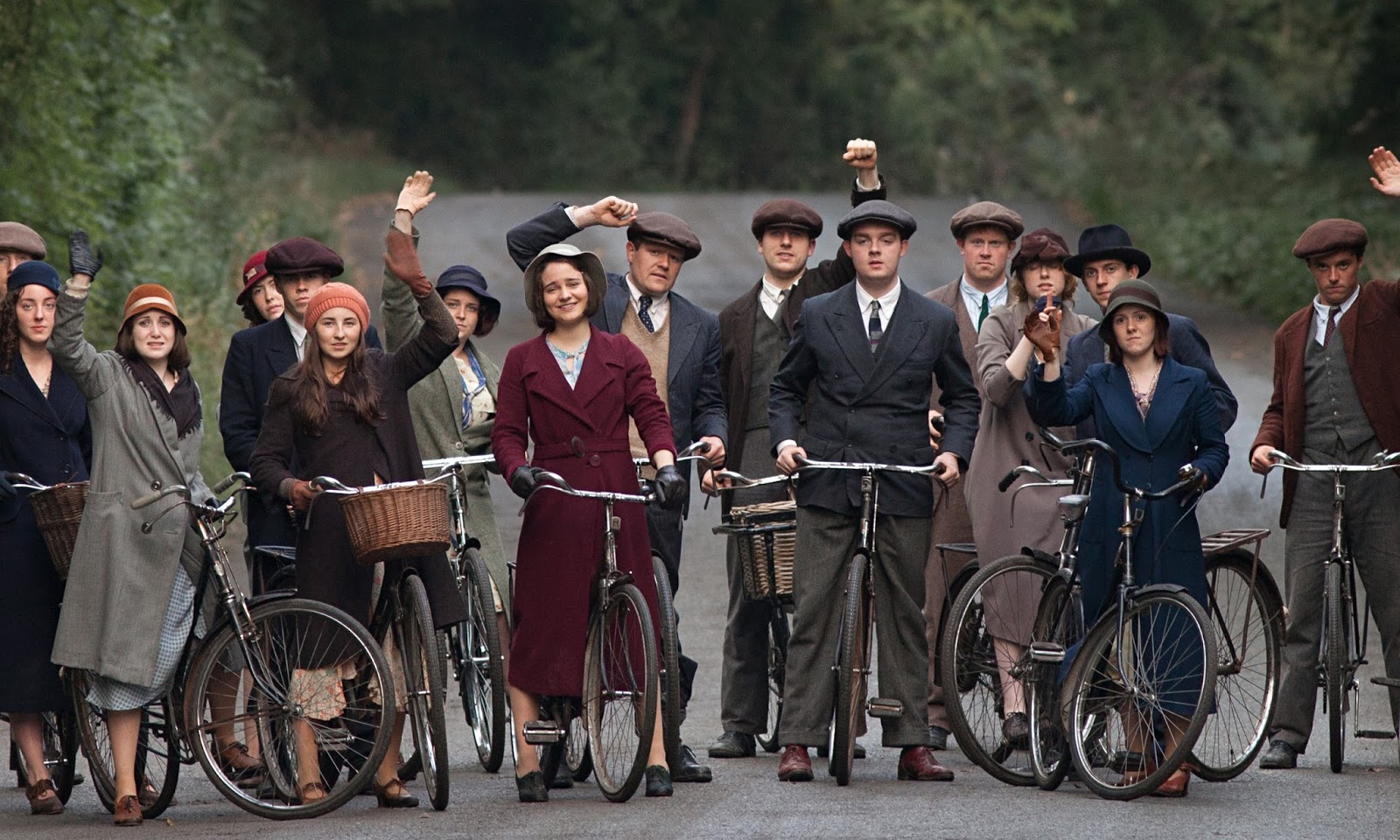
This is the story of a wonderful movie I just watched at Laemmle Cinemas: "Jimmy's Hall."  This movie is based on a true story from Ireland in the thirties.  I am telling this story to show one small example of what the ruling class and the church could do in order to stay in power.  Is there any justice or compassion in this story?
These are highlights of the true story: In 1933, Jimmy Gralton, as he was known locally, became the only Irish citizen ever to have been deported from the country when he was forcefully removed and put on a boat to America. He would never set foot in his native land again.
Such severe punishment for his ‘crimes’ seems improbable 81 years on. A dissident voice, Gralton was victimized by the political and religious establishment after daring to establish a dance hall in rural Ireland. A self-educated, community-serving man, Gralton’s hall was built to serve as a venue for the local people of Leitrim.

The youth in the village begging Jimmy to reopen his Hall.
Community dances, singing lessons, poetry appreciation sessions, boxing classes, and debates about workers’ rights were held there. It sounds innocuous. But for the Catholic Church and the Irish ruling class, the hall and the man who built it represented something dangerous and subversive — the fact that the people were beginning to think and act for themselves.


Jimmy and the orchestra


The movie clearly visualizes the story: The church continuously sabotaged Jimmy’s group.  Jimmy’s Hall was burned twice.  When the police came to deport him, his lovely old mother said: “What did I do?  I just gave him books!?”  The lady was running a mobile library.
I think all religions are guilty of ruling societies based on ignorance.  They are stuck in the ideas of tradition and orthodoxy.
I see no other way but for all religions to modernize.  We need to accept the fact that people should be educated.  That knowledge is accessible to all.  That women are equal to men.
Jimmy was talking about jazz and dancing with black people in NY.  "They actually have two legs!!"  I advocate separation of state and religion in Israel.  Although I know that the religious establishment has control over many of the personal laws.  This is despite the fact that 60% of the citizens would like the freedom in making their choices.
The Catholics have the most change to go through.  I know I am very naïve, but there needs to be an end celibacy for priests.  I read that the whole practice came about because they didn't want any land belonging to the church to be divided among the heirs.  This was pointed out clearly in Dan Brown's best seller The Da Vinci Code.
I cannot say how Islam is going to adapt to these modern times of every kid holding a cell phone with knowledge and information right at the tip of their fingers.  But I truly wish to see more justice and equality. 
I’d like to hear more voices like Jimmy’s for progressive politics.  For allowing people to use their creativity and imagination to paint and sing and dance.
Jimmy Gralton represented that alternative voice and finding a space for dissidents — and also seeing them as important alternative arguments — is a major question of our time.